A custom soccer medal is a small order with a lot of ways to go slightly wrong. The medal itself is usually fine; the trouble is in the decisions around it, the timing, the quantity, the ribbon, the artwork, that get made quickly and then can’t be undone once production starts. The good news is that the common mistakes are predictable, and every one of them is avoidable with a little planning. Here are the ones that most often cost a coach or club organizer time, money, or a medal that lands a week after the tournament.
Ordering too late for the production window
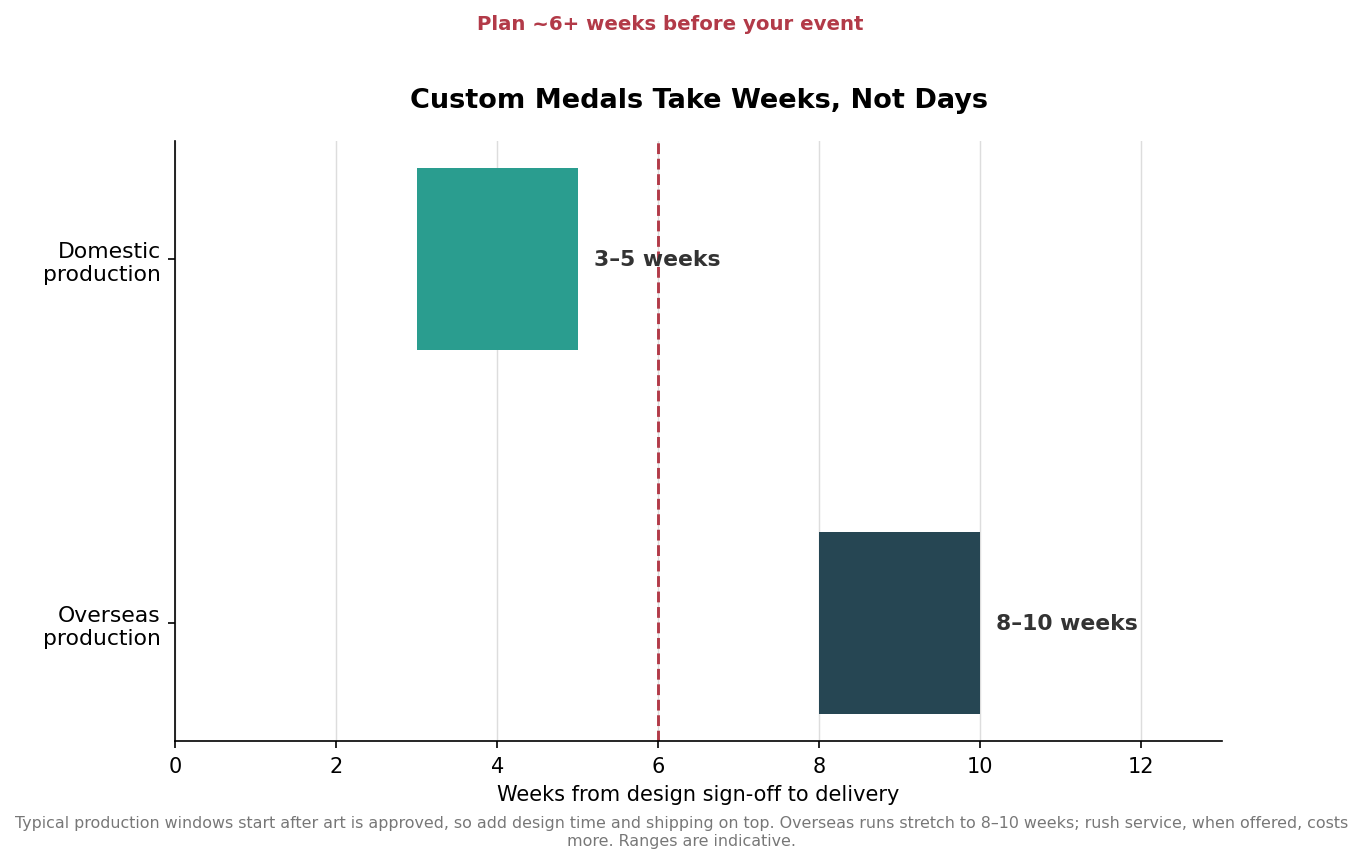
The single most common mistake is treating a custom medal like a same-week purchase. It is not. Domestic production typically runs about three to five weeks from the moment your design is approved to delivery, and if the medals are made overseas that window stretches to roughly eight to ten weeks. Two details make this worse than it looks. First, that clock starts at art sign-off, not at your first inquiry, so the back-and-forth of proofing a design happens before the production window even begins. Second, shipping sits on top of production. The practical rule is to start the conversation at least six weeks before your event, and comfortably more if you want time to review a physical proof or you are ordering from an overseas supplier. Rush service exists at many suppliers, but it costs more and narrows your options, so it is a rescue plan, not a strategy.
Under-ordering and ignoring the price tiers
The second mistake is ordering exactly as many medals as you have players today. Rosters change, a sibling wants one, a medal gets lost before the ceremony, and coaches and assistant coaches are easy to forget until the moment you are handing them out. Ordering a modest buffer over your headcount is cheap insurance against a short count that cannot be fixed in time. It also tends to work in your favor on price. Custom medals commonly fall anywhere from under a dollar to several dollars each depending on material and decoration, and per-unit cost usually steps down as quantity rises, so the marginal cost of a handful of spares is small. Decide your decoration method against that budget too: laser engraving and color-printed inserts sit at different price points, and choosing the method early keeps the quote from moving after you have committed.
Treating the ribbon as an afterthought
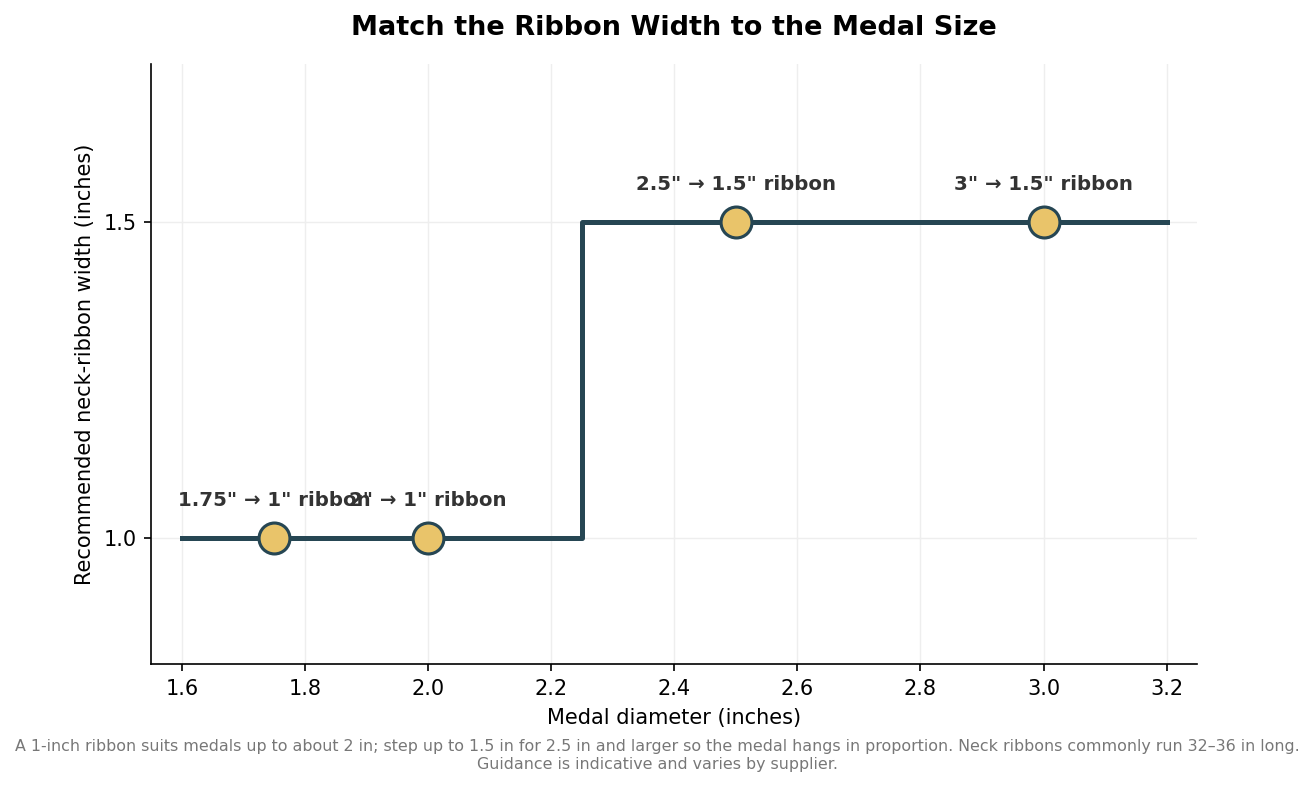
The ribbon is half of what a recipient actually sees when the medal is around their neck, yet it is the part most often left on default. Two dimensions matter. Width should track the medal size: a one-inch ribbon suits medals up to about two inches, while medals of two and a half inches or larger look out of proportion on anything narrower than about an inch and a half. Length is more forgiving but still a choice, with neck ribbons commonly running between 32 and 36 inches. The bigger decision is the ribbon’s print method. A screen-printed ribbon is fine for a simple, one- or two-color design, but if you want a sponsor logo, a club crest, or colors matched closely to the medal artwork, a sublimated ribbon is the format that reproduces full-color graphics and approximates Pantone colors. A striking medal on a flimsy, mismatched ribbon reads as cheaper than it was.
Sending artwork the process can’t hold, or the wrong size
Custom medals are made from tooling and inserts that reproduce clean shapes, not photographic detail, so the artwork you supply has to suit the method. Fine gradients, hairline text, and tiny logo elements that look crisp on a screen can close up or disappear when they are struck into metal or printed at coin scale. Supplying clean vector artwork, and simplifying detail that will not survive at an inch or two across, prevents a disappointing proof and a second round of revisions that eats into your lead time. Size is the companion decision. A two-inch medal is a sensible, economical choice for a large youth league, while a two-and-a-half or three-inch medal carries more presence and heft for a championship or an older age group. Heavier, larger medals are the ones more likely to be kept rather than tossed in a drawer, so match the size to how much the moment is meant to mean, not only to the lowest line-item price.
Skipping personalization and the final proof
The last cluster of mistakes happens at the finish line. Decide early whether the medals need a year, an event name, or a placement distinction between first, second, and third, because engraving or an insert change affects both the method and the schedule, and adding it late is where rush fees appear. Then, before you approve the run, actually read the proof against your source, the spelling of the event, the correct year, the right team name, and where the budget and timeline allow, ask for a physical sample rather than approving from a digital rendering alone. It is far cheaper to catch a wrong date on a proof than on 200 finished medals. None of these mistakes are exotic; they are ordinary decisions made in a hurry. Give the order a few weeks of runway, buy a small buffer, choose the ribbon and artwork deliberately, and read the proof carefully, and a custom medal order becomes one of the more predictable things on a season’s to-do list.