The ribbon is the part of a soccer medal a player actually wears home. It does more visible work than the extra few millimeters of medal diameter that teams tend to argue over, because a printed neck ribbon carries the club name, the tournament, the year, and a sponsor logo across a surface far larger than the medal face. Yet it is usually the last item specified on an order and the first place a design goes wrong. This walkthrough covers how to spec a ribbon that fits the medal, survives a season in a gym bag, and stays inside budget.
Start With the Medal, Then Size the Ribbon
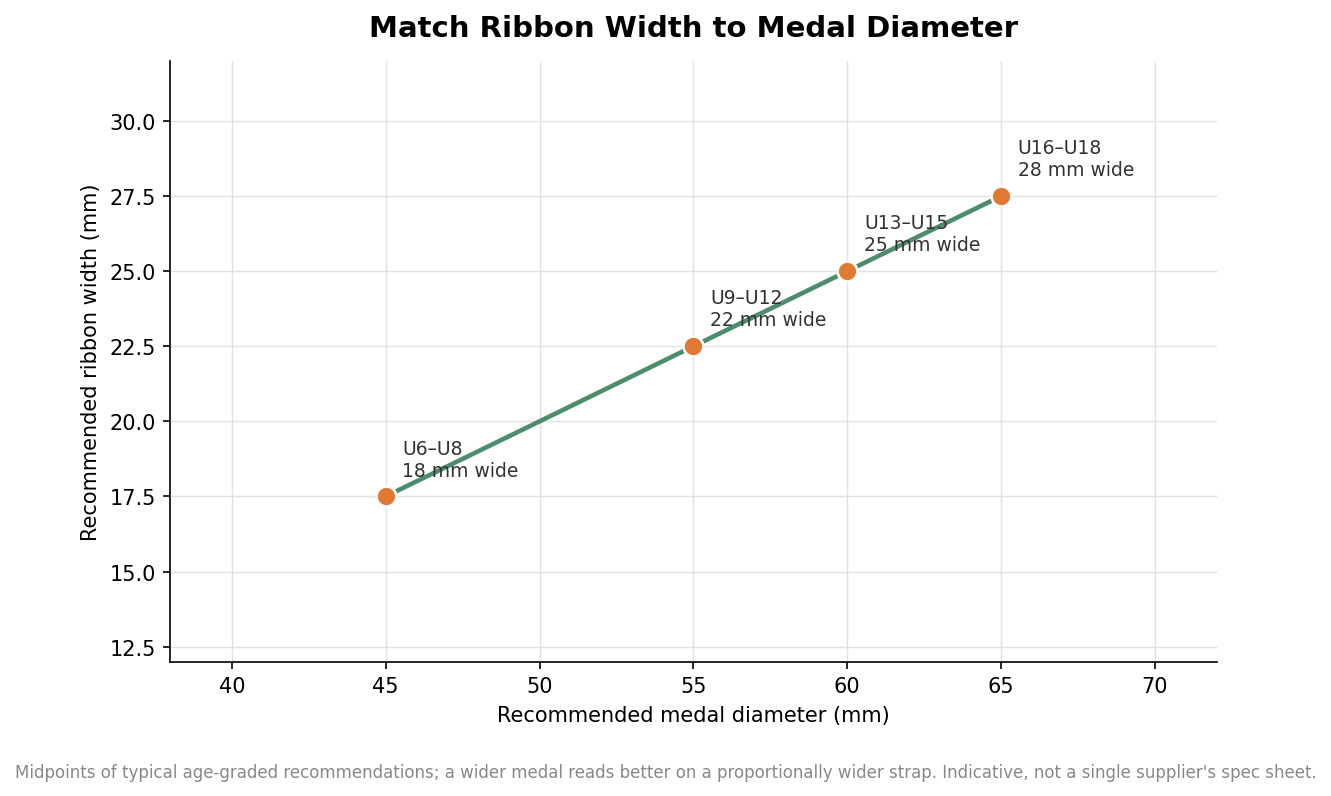
Ribbon width should track medal size rather than being chosen on its own. A common rule is a narrow ribbon of about 7/8 inch to 1 inch (roughly 22 to 25 mm) for medals 2 inches (about 50 mm) and under, stepping up to about 1.5 inches (roughly 38 mm) for anything larger, so a heavy medal does not dangle from a thin strap and a small medal does not look lost on a wide one. Youth programs often go finer: typical recommendations run about 15 to 20 mm for U6 to U8, 20 to 25 mm for U9 to U12, and 25 to 30 mm through U13 to U18. These are indicative ranges, and different suppliers round them differently.
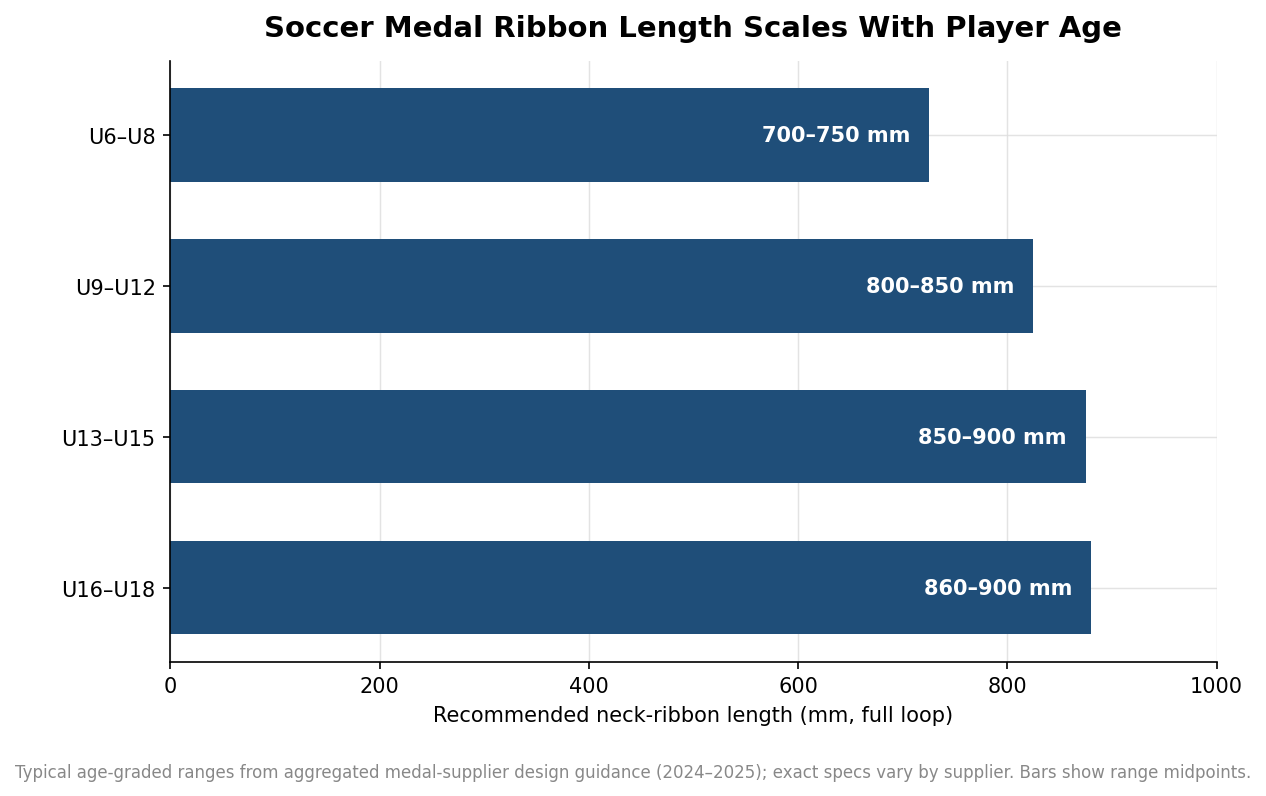
Length matters for the same proportional reason. Custom ribbon lengths commonly fall between 32 and 36 inches measured as the full loop that goes over the head, but age-graded guidance pushes shorter for small children, roughly 700 to 750 mm for U6 to U8, climbing to around 860 to 900 mm for teenagers. A medal that hangs at mid-chest on a 15-year-old will sit near the stomach of a six-year-old on the same ribbon, which looks off in team photos and is the single easiest thing to get right up front.
Material Decides What You Can Print
The webbing you choose quietly sets your decoration options. Polyester is the most common and the most practical: it is affordable, tough, and the only common material fully compatible with full-color sublimation, so if you want an edge-to-edge printed design it is effectively the default. Nylon has a firmer, more robust hand and tends to cost more, but it is generally not suited to sublimation, so it pairs better with screen printing. Satin and cotton also take screen printing well for simpler looks, while suede and waxed-cotton cords sit at the premium end for finisher medals where feel is part of the presentation. Decide the look first, then let it point you to the webbing rather than the other way around.
Choosing a Decoration Method
Dye sublimation heat-transfers the design into polyester fibers, supports unlimited colors and edge-to-edge artwork, and closely approximates Pantone (PMS) colors, which makes it the right call for multi-color club crests and sponsor logos. Screen printing lays down solid colors, typically four to five, and is more economical when the design is a one- or two-color name and year rather than a full-color graphic. Woven ribbons stitch the logo into the fabric itself for a textured, durable result that suits crests with clean shapes. Stock ribbons in solid colors and patriotic stripes carry no setup work, cost the least, and ship fastest, which makes them a sensible choice when the medal face already does the branding and the budget is tight. The jump from a stock ribbon to a custom-printed one is where most of the visible upgrade lives, often for a small per-piece premium.
Attachment, Hardware, and Safety for Young Players
How the ribbon meets the medal affects both looks and durability. A sewn loop, the standard V folded and stitched at the front, is the most common and keeps the medal centered, while a bar attachment changes how the medal lies and can restrict where a logo prints near the nape of the neck. On the hardware side, a split ring or a swivel lobster clip lets the medal rotate so the front always faces out, and direct stitching makes the attachment permanent for a cleaner look at the cost of swapability. For the youngest age groups, a snap-off or breakaway clasp that releases under a firm pull is worth specifying: it reduces the chance of a ribbon catching during rough play. None of these choices costs much individually, but they are hard to change after production, so confirm them on the proof.
How Ribbon Choices Move Cost and Lead Time
Ribbon decisions are cheaper leverage than medal upgrades. Moving from a stock ribbon to a custom-printed one commonly adds on the order of $0.15 to $0.30 per piece, an indicative figure that shifts with quantity and print method, and that upgrade is often more visible than paying for a larger medal. Minimum order quantities for a fully custom program tend to start near 100 pieces per design, though many suppliers will run stock medals with a custom-printed ribbon in smaller batches of roughly 25 to 50 when a small club needs fewer awards.
Timing is the other constraint. A full-custom run realistically spans about six to eight weeks once you account for artwork, a digital proof, mold creation of roughly 7 to 10 days, a physical sample approval, mass production of about 7 to 15 days, and around a week for freight. When a deadline is tight, printed epoxy-insert medals on a stock metal base can compress production to roughly 7 to 10 days plus shipping, which is the usual path to a sub-four-week turnaround. The practical takeaway is to lock artwork about eight weeks before the tournament, decide the ribbon at the same time as the medal, and treat the proof as the last moment to fix width, length, print method, and clasp before the order becomes final.