Ordering medals for a youth soccer tournament goes wrong in one of two directions. Either an organizer counts teams and forgets that a medal goes on every player’s neck, and comes up dozens short on finals day, or they round everything up to a safe-sounding number and end up storing three boxes of unused medals until next season. Both mistakes come from skipping the same step: deciding the award structure first and counting from the roster up.
Here is a way to size a medal order that holds up whether you are running a single-day recreational jamboree or a competitive weekend tournament with brackets in every age group.
Decide how deep the podium goes before counting anything
The first number you set is not a quantity, it is a policy: how many placing teams get medals in each bracket. A competitive tournament usually medals the champion and the finalist, so two teams per bracket. Many add a third-place bronze, awarded either through a true third-place match or to both losing semifinalists, which can mean two teams’ worth of bronze rather than one. Recreational and younger divisions often skip placement entirely and give every participant the same medal.
That single decision drives everything downstream, because the count is always the number of placing teams multiplied by the people on each team. Settle it with the tournament director in writing before you price anything, because the difference between a two-deep and a four-deep podium doubles the placement order.
Count by roster, not by team
A medal is awarded per person, so the unit that matters is roster size, and roster size is set by the playing format. Small-sided youth soccer in the United States follows a familiar ladder: 4v4 for the youngest players, 7v7 around U9 and U10, 9v9 at U11 and U12, and full 11v11 from U13 up. Governing bodies cap the small-sided rosters fairly tightly, commonly around twelve players for 7v7 and sixteen for 9v9, while 11v11 rosters are league-set and often run to eighteen dressed players or a registration list of twenty-two.
Plan placement medals against the maximum roster the division allows rather than the count you hope shows up, because the one team that carries a full bench is the team that leaves a player without a medal in the team photo. The chart below shows how the per-bracket total climbs as both the format and the podium depth grow.
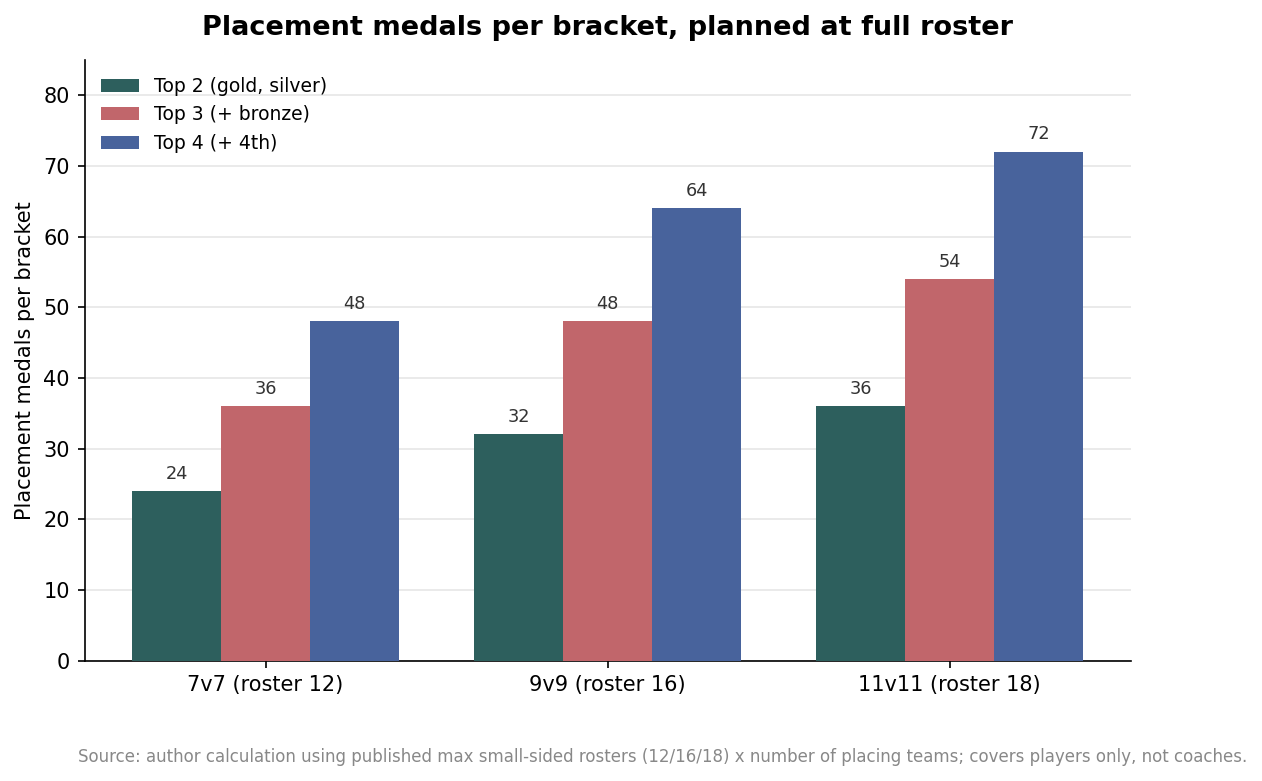
Read it as a planning ceiling, not a promise. A 9v9 bracket that medals its top three teams needs roughly forty-eight player medals at a sixteen-player roster; take the podium four deep and you are near sixty-four. Real rosters are often smaller, so you will usually have a few left over, which is exactly what you want as insurance against a miscount at the medal table.
Participation tournaments are a different order entirely
The math changes completely when every player receives a medal. Now you are not multiplying by the two or three placing teams in a bracket, you are multiplying by every team in it. An eight-team bracket that medals only its podium needs medals for three rosters; the same bracket run as a participation event needs medals for all eight, which is close to triple the count for that one division.
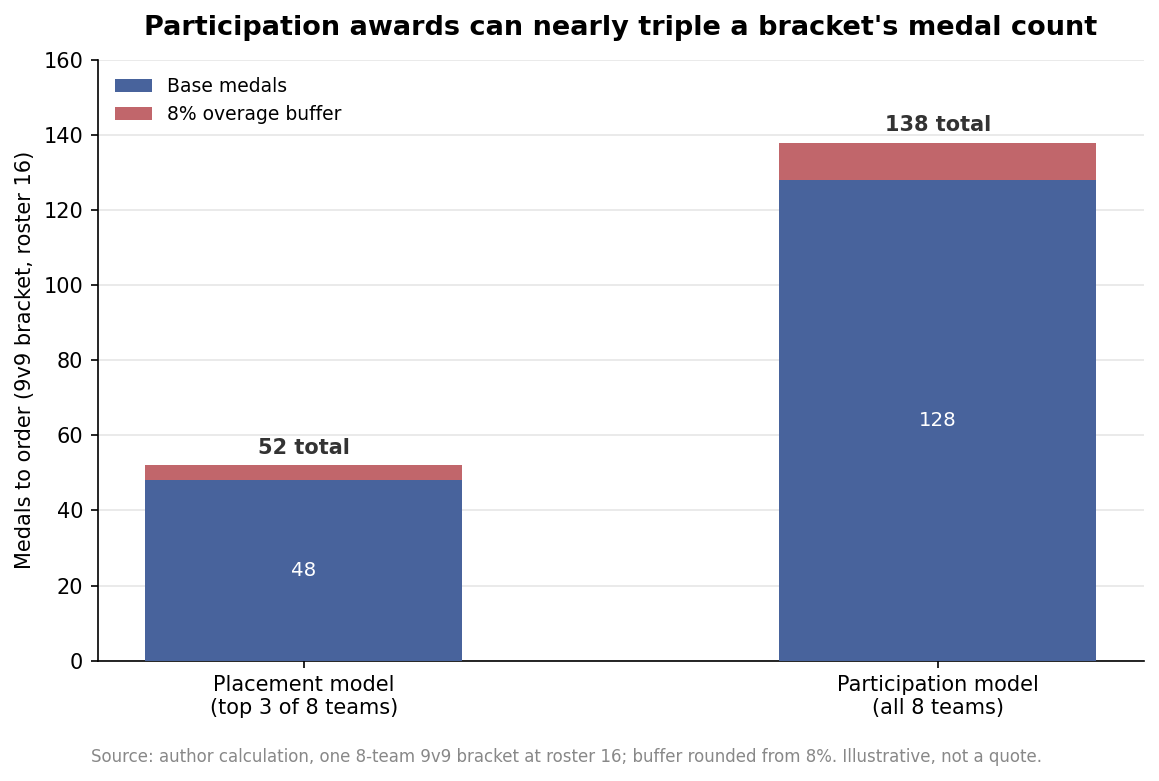
That is not an argument against participation medals, which are the whole point of an entry-level event and often the reason families sign up. It is an argument for knowing which model you are running before you look at any price per medal, because a per-unit discount that looks generous on a placement order can be swamped by a participation order that is three times larger. If you run both models across different age groups in the same tournament, count them separately and add them, rather than applying one assumption to the whole event.
Coaches, buffer, and lead time
Two additions turn a clean calculation into a realistic order. Coaches and team staff generally expect a medal too, so add two or three per placing or participating team depending on how many adults you recognize. Then add an overage buffer on top of the whole order, commonly in the range of five to ten percent, to absorb damaged medals, last-minute add-on teams, and the player who insists the ribbon snapped. On a large participation order even a modest percentage is a real number of medals, so decide the buffer deliberately rather than eyeballing it.
Lead time is the constraint that turns a good plan into a stressful one. Custom soccer medals are made to order, and a design with a bespoke mold, specific enamel colors, or a printed insert takes longer to produce and ship than a stock medal pulled from a shelf. Lock your quantity early enough that a production and transit window of several weeks still lands comfortably before the tournament, and confirm the exact ship date with your supplier rather than assuming the quoted turnaround starts the day you first inquire. Where a figure like turnaround or buffer is a rule of thumb rather than a guarantee, treat it as one and build in slack.
Putting it together
Work the order in one pass. Write down each bracket, its format and maximum roster, and whether it is placement or participation. For placement brackets, multiply the roster by the number of placing teams; for participation brackets, multiply the roster by every team. Add coaches per team, sum every bracket, then apply your overage percentage to the grand total. The number you get is defensible, ties back to a policy you set on purpose, and leaves you with a small, intentional cushion rather than a surprise shortage or a closet full of next year’s problem.