Two decisions set almost everything about a custom soccer medal: how big it is and how it is made. Diameter drives the presence it has around a player’s neck and most of its weight, while the construction method decides whether it can carry deep three-dimensional detail or only a flatter relief, and what it costs at the quantities a league actually orders. Get those two right and the plating, ribbon, and packaging are straightforward. This is a side-by-side look at the specs that matter so you can match the medal to the event and the budget.
Size: what each diameter buys you
Soccer medals cluster in a narrow band of sizes, and the differences are more meaningful than they look on a screen. A 2-inch medal (about 50 mm) is the economical choice for large youth participation runs where every player gets one. The 2.5-inch medal (roughly 63 mm) is the workhorse for tournament placement awards and is the size most parents picture when they think of a sports medal. Step up to 2.75 inches (about 70 mm) or 3 inches (about 76 mm) and you get noticeably more face area for a crest, sponsor logo, or event date, which suits championship and adult-league awards. Die-struck construction can go as large as 90 mm (3.5 inches) if you want a statement piece.
Thickness usually rides along with size and quality tier. A typical sports medal runs around 3 mm thick, while premium die-struck pieces can reach 8 to 12 mm for a substantial, heavy feel. Weight scales accordingly: a 50 mm zinc-alloy medal commonly falls in the 20 to 50 gram range depending on thickness and how much metal the design leaves in place. Heavier is not automatically better, but that heft is a large part of why a medal feels like an award rather than a token.
Die-cast zinc versus die-struck iron
Construction is the fork in the road. Die-cast medals are made by injecting molten zinc alloy into a mold, which lets the design carry deep contours, undercuts, and genuine three-dimensional shapes such as a raised soccer ball or a sculpted player. Die-struck medals are stamped from sheet metal, typically iron, steel, or brass, under high pressure, producing a cleaner but flatter relief that reads as classic and refined. If your artwork depends on 3D depth, die-cast is the honest answer; if it is a crisp two-dimensional emblem, die-struck delivers a sharp, traditional look and is often the sturdier stamped piece.
Material cost tracks the choice. Zinc alloy dominates the value segment for a reason: by one industry estimate it is used in roughly 80 percent of custom medals priced under five dollars a unit. Brass, prized for a premium die-struck finish, tends to run two to three times the material cost of zinc. If you want a true bronze rather than a bronze-colored plating, note that real bronze is about 90 percent copper and 10 percent tin, which is a different and pricier proposition than a bronze finish over zinc.
Plating, color, and finish
Most soccer awards still come as the familiar gold, silver, and bronze trio, and those are plating finishes applied over the base metal rather than solid precious metal. You can specify a bright polished plating for a shiny modern look or an antique finish that settles color into the recesses for depth and an heirloom feel. Where you want brand or team colors on the medal face, enamel is the tool. Soft enamel sits slightly below the metal ridges and gives a textured, tactile surface, while hard enamel is polished flush and scratch-resistant for a smoother, more durable finish. Soft enamel is the more economical of the two and is perfectly appropriate for most league and tournament work.
Ribbons: the detail buyers forget to spec
The ribbon is not an afterthought; it is the first thing a recipient touches. Stock ribbons in solid colors or simple stripes are the budget option and typically add around fifty cents per medal. A custom sublimated ribbon printed with your league name, sponsor, or event branding runs closer to a dollar and a half each and usually carries a one-time setup charge in the neighborhood of fifty dollars. Neck ribbons commonly measure about 7/8 inch wide and roughly 32 to 36 inches in looped length, comfortable for both youth and adult wearers, though widths and lengths vary by supplier, so confirm the exact dimensions before you approve. For a tournament with recurring sponsors, a custom ribbon is often the highest-impact upgrade for the money.
Quantity, lead time, and budgeting the order
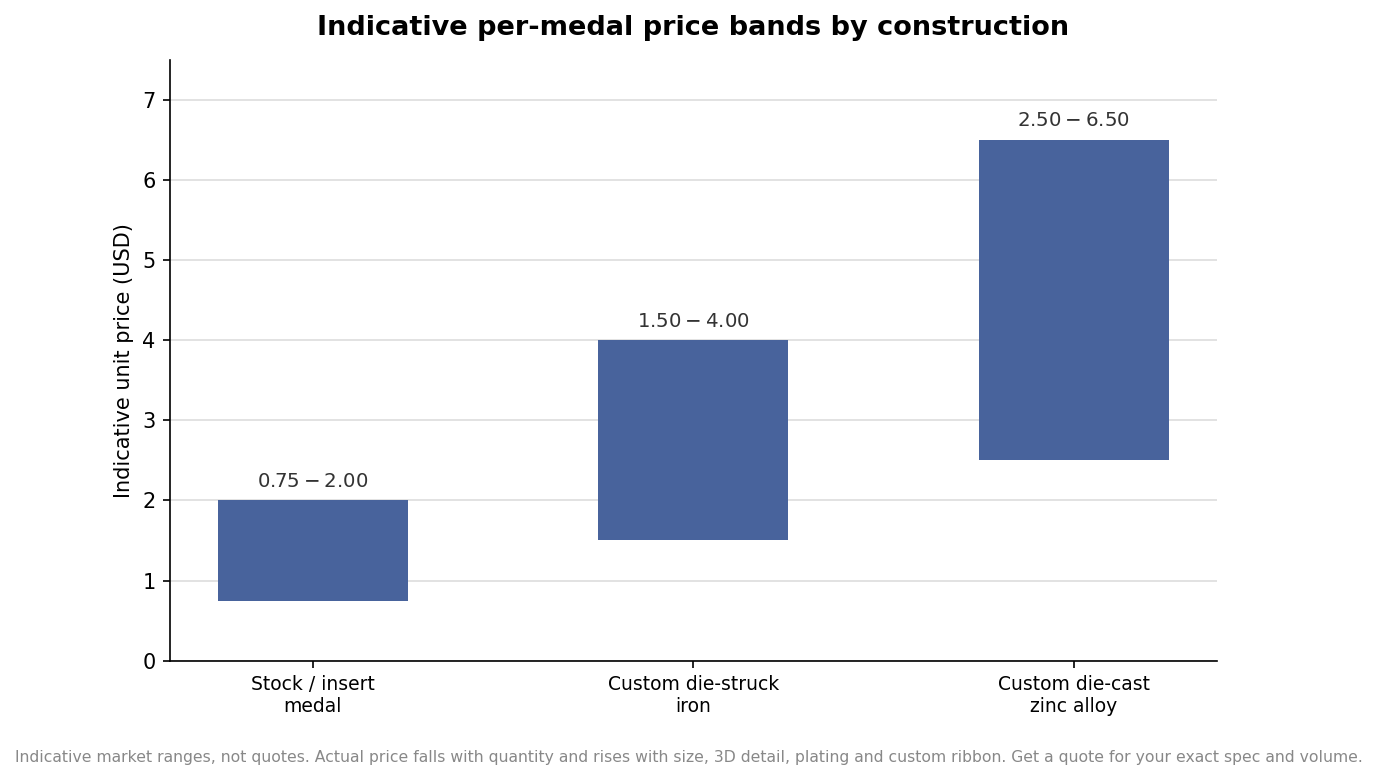
Custom metal medals generally carry a minimum order around 100 pieces, since the mold or die is cut once and then amortized across the run. That tooling is why unit price drops steeply as quantity climbs, and it is worth ordering to your realistic full-season need rather than reordering in small batches that each shoulder setup costs again. As an indicative guide, stock or insert-style medals often land between roughly $0.75 and $2.00 each, custom die-struck iron between about $1.50 and $4.00, and custom die-cast zinc between roughly $2.50 and $6.50, with the exact figure moving on size, detail, plating, and ribbon. Treat those as market ranges to sanity-check a quote, not as a price list.
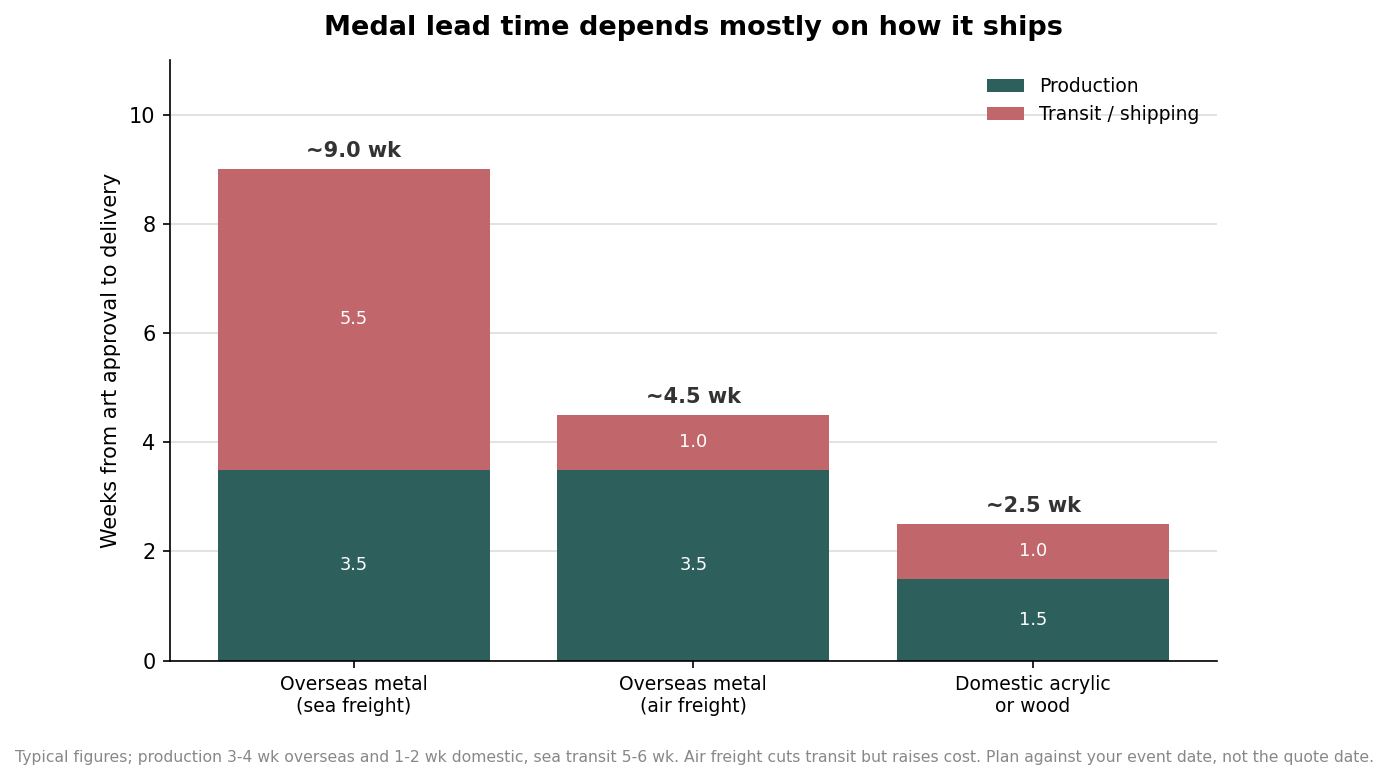
Lead time is where tournament orders most often go wrong. Overseas-produced metal medals typically need three to four weeks of production plus five to six weeks of sea transit, so eight to ten weeks from art approval to delivery is a realistic plan. Air freight can compress the transit to about a week but adds meaningful cost, and domestic acrylic or wood medals can turn in roughly three to five weeks total when metal timelines are too tight. The practical rule is to count backward from your event date, not forward from the day you place the order, and to lock artwork early, because approval delays eat directly into the production window. Decide size and construction first, add the plating and ribbon that fit the occasion, and order enough lead time that the medals are on the table before the whistle blows.
Win Free Stuff
Enter below for a chance to win plus receive 10% off your first order.
🎉 You are in!
Check your email for your 10% off code. Good luck!